
ViaBTC’s referral program can add a second revenue stream without requiring a referrer to buy more ASICs or add electrical capacity. ViaBTC says its Ambassador program distributes 20% of the platform fee revenue generated by referred miners to eligible ambassadors, while qualification examples include referred hashrate of BTC ≥300 TH/s, LTC ≥5 GH/s, or KAS ≥10 TH/s. ViaBTC also reports service across 150+ countries and regions and more than 1 million users. For miners comparing referral economics, pool charges matter just as much: current PPS+ block-reward fees are 4%, while PPLNS is 2%.
Mining referral economics become easier to understand when the reward is separated from mining revenue itself. ViaBTC states that an Ambassador receives 20% of the platform’s fee revenue generated by a referred user, rather than 20% of that miner’s total mined coins. If a referred operation generated $10,000 of fee-applicable mining volume under a hypothetical 4% charge, the pool fee would be $400; 20% of that amount would equal $80. Actual calculations depend on the eligible coin, settlement method, account status, and current program terms.
That fee basis makes the pool’s charging structure relevant before estimating referral income. Current ViaBTC Pool Fees show a 4% fee on the PPS block-reward component under PPS+, while transaction fees distributed through its PPLNS component carry a 2% fee; standard PPLNS also lists a 2% fee. ViaBTC says PPS+ block rewards are settled hourly using current difficulty, while PPLNS distribution uses a miner’s share of pool hashrate over the past 5 difficulty rounds after a block receives 6 confirmations.
| Item | Current published figure | Why a referrer should care |
|---|---|---|
| Ambassador reward | 20% of platform fee revenue | Reward follows referred mining activity |
| BTC invited hashrate example | ≥300 TH/s | Relevant to Ambassador eligibility |
| LTC invited hashrate example | ≥5 GH/s | Gives Scrypt operators another route |
| KAS invited hashrate example | ≥10 TH/s | Extends eligibility beyond BTC/LTC |
| PPS+ block-reward fee | 4% | Larger fee base than 2% PPLNS |
| PPLNS fee | 2% | Lower charge changes referral economics |
| PPLNS calculation window | 5 difficulty rounds | Payout timing differs from PPS+ |
| Block confirmation requirement | 6 confirmations | Relevant to settlement timing |
ViaBTC notes that Ambassador hashrate requirements may be adjusted, so the 300 TH/s, 5 GH/s, and 10 TH/s figures should be treated as current published examples rather than permanent thresholds. Applications are also evaluated using referral count and hashrate performance. That qualification model favors referrers who can bring active miners rather than accounts that register but never connect machines.
A referral account and a productive mining referral are not the same thing. ViaBTC’s published Ambassador requirements put measurable hashrate into the qualification process, including BTC ≥300 TH/s in the current example.
The distinction matters for mining farms, hosting companies, hardware communities, and technical publishers. A hosting operator working with 20 clients does not need every client to own a large farm; combined referred hashrate can become material. At 150 TH/s per BTC client, only 2 comparable clients represent 300 TH/s. The operator’s own mining equipment does not have to increase for the referred hashrate to grow, although every referral still needs to meet ViaBTC’s applicable rules.
Physical expansion has a very different cost profile. Ten 3.5 kW ASIC miners consume 35 kW before ventilation and other site equipment. Running continuously for 30 days gives 25,200 kWh of machine electricity consumption. At $0.06/kWh, that is $1,512; at $0.09/kWh, it becomes $2,268, a 50% increase caused only by the electricity rate. Referral participation does not require the referrer to supply those additional 25,200 kWh, so audience growth and hashrate ownership can be evaluated separately.
That separation becomes useful after the Bitcoin block subsidy change of 2024. The subsidy fell from 6.25 BTC to 3.125 BTC per block at the fourth halving, cutting the subsidy component by 50%. Pool selection cannot reverse a protocol-level reduction, while fee levels, accepted shares, uptime, transaction-fee distribution, and secondary referral payments remain items miners can compare. A referral payment should therefore be recorded separately from machine-level production when calculating monthly performance.
ViaBTC’s PPS+ design also affects how a miner may evaluate the service being recommended. The pool describes PPS+ as paying theoretical block rewards for valid shares while allocating transaction-fee rewards separately under PPLNS rules. The pool carries pool-luck and orphan-block risk for the PPS portion and charges a higher fee for it. Standard PPLNS charges 2% and connects payment more closely to blocks actually found. A referral recommendation should explain this difference because a miner choosing 4% PPS+ may have different cash-flow preferences from one choosing 2% PPLNS.
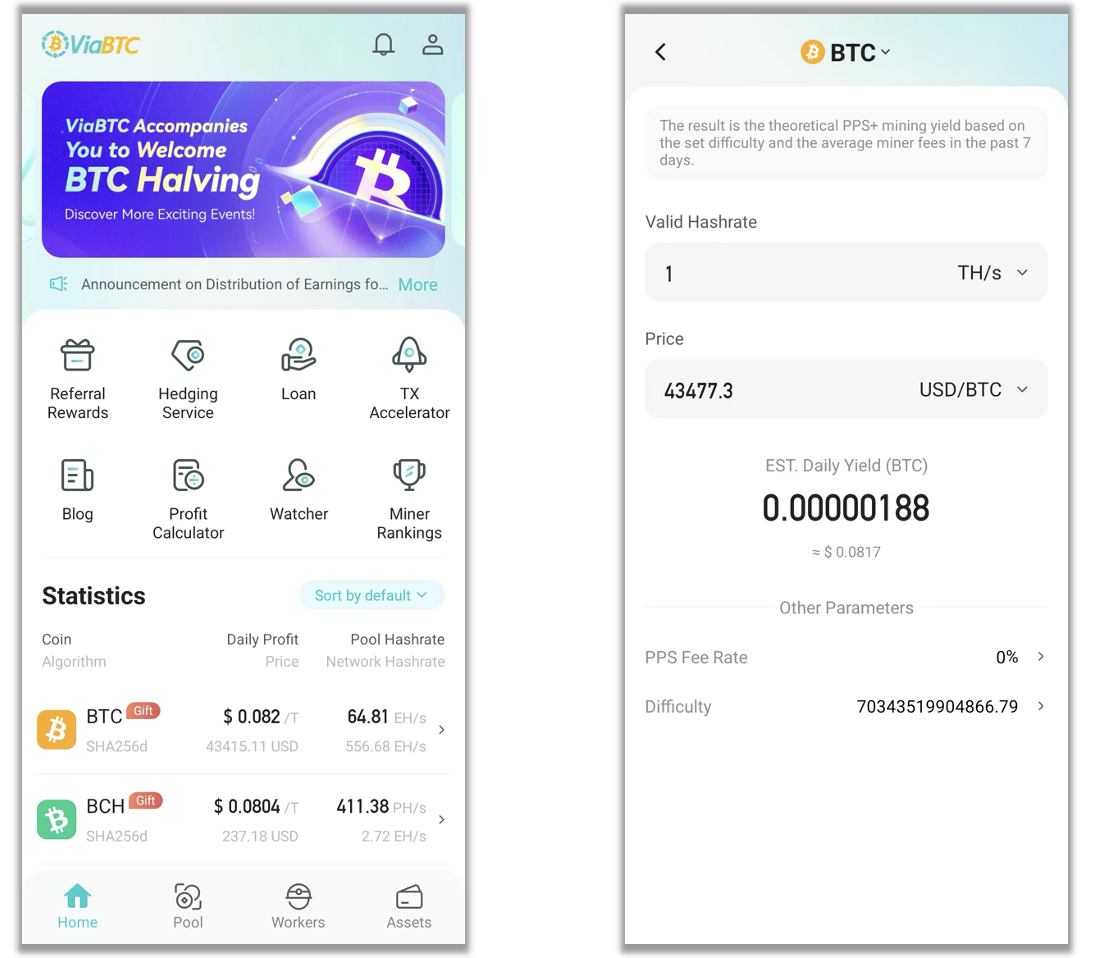
For example, ViaBTC’s pricing page currently estimates BTC PPS+ daily output at about 0.00000048 BTC per TH/s, based on data from the previous 7 days. The company explicitly labels the figure as an estimate and notes that actual output may differ. At 300 TH/s, multiplying the displayed reference rate gives about 0.000144 BTC per day before considering machine uptime, rejected shares, changing difficulty, and later changes in the published estimate.
Seven-day pool estimates are useful for short comparisons, but they are not 30-day guarantees. Network difficulty can change, transaction fees vary, and a machine running at 95% effective uptime will not behave like one maintaining 99% effective uptime.
Referral economics therefore need an operating record rather than a screenshot of one day’s estimated output. A farm can record referred hashrate, accepted-share rate, settlement method, pool fees, referral credit, electricity expense, and machine uptime each month. If a 300 TH/s group averages 97% effective availability, its effective contribution is closer to 291 TH/s during that period. Improving availability from 97% to 99% raises effective hashrate by roughly 2.06% without adding nominal capacity.
ViaBTC’s scale provides another consideration for people referring miners in several markets. The company currently states that it serves 150+ countries and regions, has more than 1 million users, maintains global node deployment, and provides 24/7 mining-network operation. A referrer working with miners in North America and Europe can therefore discuss one pool environment rather than building a referral approach around a single local mining market.
Multi-asset support adds another layer. ViaBTC’s current fee page lists reference PPS+ output for BTC, BCH, LTC, ZEC, DASH, and KAS, while its merged-mining section lists additional assets attached to BTC or LTC mining. For a referrer, a mixed group of SHA-256, Scrypt, and other compatible miners is more useful than an audience limited to one machine type, provided each referred miner meets current program conditions.
Merged mining can also affect what miners receive without requiring a second set of machines for every associated asset. ViaBTC currently states that LTC mining can include DOGE and several other listed merged-mining assets, while BTC mining includes listed auxiliary rewards such as NMC. The amounts and supported assets should be checked when hashrate is connected because a 2026 fee or merged-mining page is more relevant than an older promotional article.
The referral process itself is short. ViaBTC says an account receives a referral link or code, the user shares it, and rewards can begin when invited users register and start qualifying mining activity. Ambassador links are automatically upgraded for approved ambassadors, according to ViaBTC’s published FAQ, so an existing referrer does not need to replace the basic relationship manually after approval.
For a commercial operator, reporting should still separate three numbers: gross mining production, pool charges, and referral credits. Assume an operation records $40,000 in monthly mined value, $1,600 in applicable pool charges, and $250 in referral credits. Reporting $40,250 as “mining revenue” would obscure the source of the extra $250; keeping referral credits separate makes month-to-month comparisons clearer, particularly when difficulty, coin price, or hashrate changes by 10% or more.
The same separation helps compare purchasing another ASIC with developing an existing miner network. A new machine requires hardware capital, perhaps 3–4 kW of continuous electricity, site capacity, cooling, maintenance, and repair allowance. A referral relationship mainly requires qualified users who actually mine. The referrer is not buying the referred hashrate, although the amount credited still depends on ViaBTC’s program terms and the referred miners’ eligible activity.
A miner should also avoid treating the 20% Ambassador figure as a fixed percentage of personal mining output. ViaBTC specifies 20% of platform fee revenue generated by referred users, and it reserves the ability to adjust hashrate requirements. Before projecting 6 or 12 months of referral payments, check current eligibility, applicable fee rates, qualifying assets, account restrictions, settlement records, and whether the referred hashrate remains active.
For miners already introducing other operators to pools, the program can attach measurable compensation to an activity they may already perform. The useful comparison is numerical: 4% versus 2% pool charges, 20% of eligible platform fee revenue for approved Ambassadors, current qualification examples of 300 TH/s BTC, 5 GH/s LTC, or 10 TH/s KAS, plus actual referred hashrate over the billing period. Those figures allow a miner to compare referral credits with electricity, hardware, uptime, and pool costs using the same monthly accounting period.