
A quotation does not hide costs so much as leave scope undefined, and the undefined parts are what get billed later. For a refillable fragrance the risk is higher because the pack has more parts, more tolerances and more testing assumptions than a sealed bottle. The workable defence is a checklist: for every line in the estimate, insist on knowing what is included, what is excluded and what triggers a change.
Key takeaways
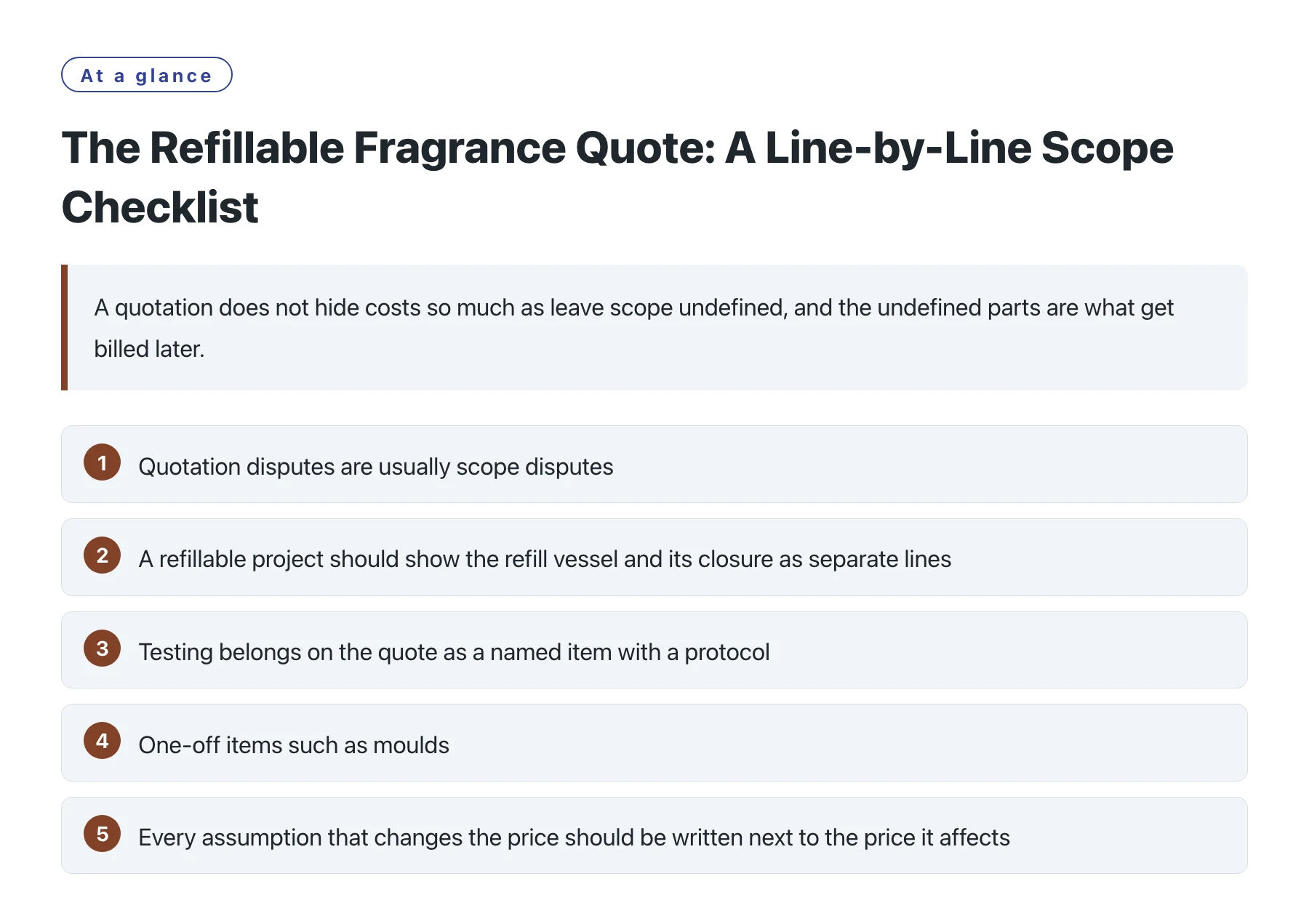
- Quotation disputes are usually scope disputes, so the checklist should be built around inclusions and exclusions rather than around the total.
- A refillable project should show the refill vessel and its closure as separate lines, because they are separately sourced and separately tested.
- Testing belongs on the quote as a named item with a protocol; an unlabelled testing allowance is impossible to audit.
- One-off items such as moulds, decoration plates and print setup should be listed apart from repeat unit cost.
- Every assumption that changes the price should be written next to the price it affects, including quantity, fill volume and oil load.
Two quotations for the same brief can differ by a wide margin without either supplier being dishonest. One has priced a scope that includes compatibility testing and artwork adaptation; the other has priced the filling step and left the rest to be raised later.
The way to see which is which is not to compare totals but to compare the item lists. This article sets out the lines a refillable fragrance quote should contain, what each line is worth checking for, and the places where cost most often appears after signature.
The lines to look for, and what each one can conceal
| Quote line | What it should state | What it can conceal when vague |
|---|---|---|
| Fragrance compound | Oil load as a percentage, and whether the accord is library or developed for the brand | A lower load than the sample implied, or a licence fee for an accord treated as an extra |
| Fill and assembly | Fill volume, line, and whether crimping, capping and labelling are all inside the figure | Manual finishing, rework or a second pass billed as a separate operation |
| Primary pack | Bottle, pump, cap and any decoration, named by component and finish | Decoration setup treated as a one-off after the unit price was agreed |
| Refill vessel and closure | Component source, seal design and the number of open-close cycles the design targets | A generic refill that fits the bottle in theory but fails in repeated use |
| Compatibility and stability testing | Protocol, duration, conditions and acceptance limits | Testing that was never scheduled, or that is billed again at each reformulation |
| Artwork and regulatory adaptation | Which market the label artwork is prepared for and who checks the wording | Local ingredient and allergen listing prepared by the brand at its own cost |
| Carton, leaflet and shipping pack | Materials, print method and whether the shipper is included | Protective packaging added later, once the refill has to travel without leaking |
| Tooling and setup | Each mould, plate and print cylinder listed with its owner and its amortisation | Setup charged as unit cost, so the brand pays for it again on every order |
Take your last quotation and mark each row as present, absent or unclear. The unclear rows are where the next conversation should start.
Three places cost appears after signature
Regulatory scope assumed rather than agreed
A cosmetic product placed on the European market needs a responsible person and a notification before it is sold, and the labelling has to carry the ingredient information the rules require [1]. Suppliers vary in how much of that work they take on. Some prepare the product information file, some only supply the technical data the brand needs.
The gap is expensive when it is discovered late, because artwork has to be redone and the launch date moves. The cheap fix is a single question on the quote: which market has this artwork been prepared for, and who signs off the ingredient declaration?
Claims are the second half of the same problem. Cosmetic claims are expected to be substantiated and not misleading, and the requirements are published rather than negotiated [2]. If the brand intends to describe the product as refillable or as using a certain class of materials, that wording should be checked against the market before the label is printed.
Material restrictions discovered at the testing stage
Fragrance materials are restricted per material and per product category, and the standards are public [3]. A formula that is compliant in one format may need adjustment in another, particularly when the format or the application method changes between the sample and the final pack.
The cost of that adjustment is rarely the perfumer's time. It is the second stability round, the new artwork and the delay. Ask the supplier to state, on the quote, who pays for a reformulation caused by a restriction and how long the resubmission takes.
Quantities that drift below the priced break point
Most suppliers price in steps. A quote written for a larger quantity may not survive a first order that is smaller, and the difference is not always disclosed in the total. Get the break points in writing, with the price at each one, and treat the smallest viable run as the working figure for planning rather than the number the brand hopes to reach later.
The same applies to the refill. If the refill is priced at a different quantity from the primary pack, the two lines can move independently, and the format's economics change even though nothing about the product has.
Making the quote comparable
Once the same checklist has been applied to two or three suppliers, comparison becomes possible and usually produces a surprise: the difference between estimates is concentrated in a handful of scope lines rather than spread evenly. Those lines are where the negotiation actually belongs.
If the project is being run as private label rather than fully bespoke development, the picture simplifies, because private label fragrance production prices a narrower scope: the brand chooses from existing accords and the supplier handles filling, packaging and documentation. That is a legitimate route, and it should be quoted on its own terms rather than as a discount on a custom programme.
The companion piece to this checklist, which walks through the same arithmetic line by line, is worth keeping open next to a quotation as it arrives — Read more.
One scope distinction is worth fixing early, because it changes the item list. Where the brand needs an accord created for it, custom fragrance R&D and production has to be priced as its own phase, with its own sampling and testing lines, rather than absorbed into the filling figure.
Before comparing totals, compare item lists. A higher quote with everything named is frequently cheaper than a lower quote with testing, decoration setup and artwork left open.
Sources
- European Commission: Cosmetics in the EU —— The European Commission's overview of EU cosmetics rules, including the responsible person, product information file and safety report requirements.
- European Commission: Cosmetic Products — Specific Topics —— EU pages covering specific cosmetics topics such as product claims, nanomaterials and animal-testing rules.
- International Fragrance Association (IFRA) —— IFRA is the global trade association of the fragrance industry; its site publishes the IFRA Standards, positions and science on the safe use of fragrance materials.
Frequently asked questions
How many suppliers should I get quotes from?
Two or three is usually enough. More than that consumes time and tends to produce quotes that are not genuinely comparable, because each supplier interprets an open brief differently.
Should testing appear as a separate line on a quotation?
Yes. Testing has a protocol, a duration and an owner. A named line can be checked and scheduled; a generic allowance cannot be audited and is often the first item to be deferred.
Why do refillable projects attract more hidden cost?
They carry more components and tighter tolerances, and the refill has to perform repeatedly rather than once. Additional compatibility work and more careful packing for transport are normal, and both should be visible on the quote.
Is a tooling charge normal for a refillable pack?
It can be, if a mould or a decoration plate is made for the brand. Ask who owns the tool and how the cost is amortised, because ownership affects what happens if the brand later changes supplier.
What is the single most useful question to ask about a quote?
Ask what is not included. Suppliers answer that question more precisely than they answer questions about price, and the answer usually reveals where the difference between two estimates sits.