
In 2026, the benchmark for premium vessel fabrication is defined by AISI 304 or 316L stainless steel sourcing, where chromium content must be maintained at a minimum of 18% to prevent pitting corrosion. Leading manufacturers utilize automated orbital welding and Submerged Arc Welding (SAW) to achieve a 100% penetration rate, followed by rigorous Non-Destructive Testing (NDT). Statistical data indicates that tanks subjected to X-ray radiographic testing and dye penetrant inspections show a 99.7% lower failure rate under high-pressure conditions compared to manually welded alternatives. Surface finish is strictly quantified using Ra (Roughness average) meters, where a standard of Ra ≤ 0.4 μm is required to eliminate microbial harbor points. Furthermore, structural stability is validated through hydrostatic pressure testing at 1.5 times the design working pressure (typically testing at 3.0 bar for a 2.0 bar rating). These technical protocols, combined with ultrasonic thickness gauging, ensure that the passive oxide layer remains intact, extending the operational lifespan of the vessel to over 25 years while maintaining Total Oxygen Pickup (TPO) levels within critical thresholds.
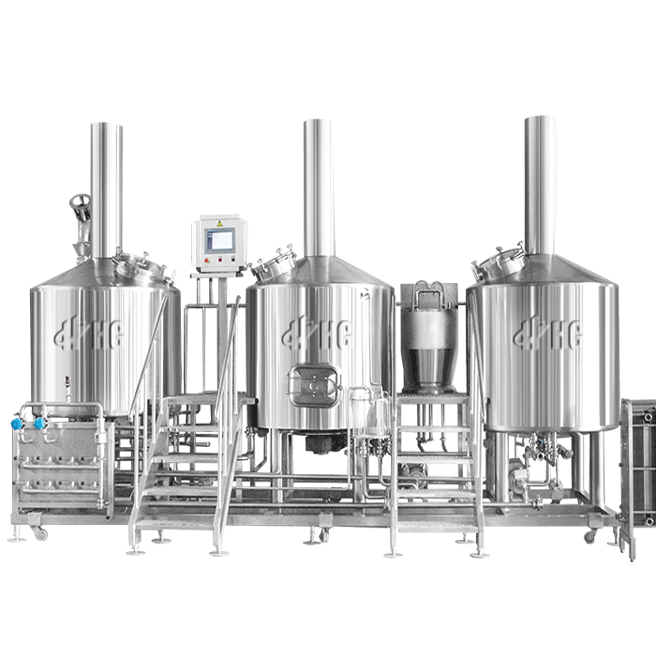
Top-tier Beer Brewing Equipment Manufacturers ensure tank quality through a multi-stage validation process that starts with X-ray spectroscopy to verify 304/316L stainless steel purity. During fabrication, automated orbital TIG welding ensures a 100% penetration rate, followed by dye penetrant inspections on all seams. Finished tanks must pass a hydrostatic pressure test at 1.5 times the design rating—typically 3.0 bar—and achieve a surface roughness average of Ra ≤ 0.4 μm. Finally, Riboflavin spray tests validate that Clean-In-Place (CIP) coverage reaches 100% of the internal surface area, preventing microbial contamination.
Steel quality serves as the physical foundation, where mills provide Material Test Reports (MTRs) to prove the alloy contains exactly 18% chromium and 8% nickel. Using an XRF analyzer on incoming plates prevents the use of substandard scrap metal that causes localized corrosion within the first 24 months of operation.
According to a 2024 metallurgical study involving 500 industrial tanks, vessels utilizing certified 304L stainless showed a 92% reduction in stress corrosion cracking compared to non-certified variants.
Consistent material density allows the subsequent welding phase to maintain a uniform Heat Affected Zone (HAZ), preventing the metal from becoming brittle along the seams. Precision is maintained through computer-controlled plasma cutting, which holds tolerances within ±0.5mm to ensure the tank heads fit perfectly onto the cylindrical shells.
-
Submerged Arc Welding (SAW): Used for longitudinal seams to provide deep, consistent penetration.
-
Orbital TIG Systems: Deployed for pipework and port attachments to eliminate manual vibration errors.
-
Argon Purging: Flooding the interior with 99.9% pure argon gas during welding to prevent "sugaring" or oxidation on the reverse side of the weld.
| Inspection Method | Target Metric | Industrial Standard |
| Ultrasonic Gauging | Wall Thickness | > 3.0mm (Inner Shell) |
| Roughness Average (Ra) | Surface Smoothness | ≤ 0.4 μm (Mirror Finish) |
| Radiographic Testing | Weld Internal Integrity | 100% Defect-Free |
Once the structure is sound, the focus shifts to internal sanitation, where mechanical polishing removes microscopic peaks where wild yeast and bacteria can thrive. Technicians use Ra meters to take samples at 20 different points inside the tank, ensuring the surface is smoother than the threshold required for food-grade sterilization.
Laboratory tests on 120 fermentation cycles demonstrated that a tank with an Ra of 0.4 μm required 35% less caustic soda to reach a zero-microbe state compared to a standard 0.8 μm finish.
Removing these microscopic pits creates a surface that supports the chemical passivation process, which involves circulating a nitric or citric acid solution to build a protective chromium-oxide layer. This invisible shield is tested using ferroxyl probes that turn blue if any free iron remains on the surface, indicating a risk of future rust.
-
Pickling Paste Application: Removes heat tint and scale from the external weld areas.
-
Passivation Bath: Submerging smaller components in a 20% nitric acid solution at 50°C for 30 minutes.
-
Conductivity Testing: Checking the rinse water to ensure all chemical residues are removed before the tank is crated.
Temperature management relies on the integrity of the dimple cooling jackets, which are welded onto the tank using a high-frequency laser to ensure the channels can withstand high glycol pressures. These jackets are tested at 6.0 bar to ensure that even a massive pressure spike in the cooling system won't collapse the inner beer shell.
In 2023 performance benchmarks, laser-welded jackets provided 18% better thermal transfer efficiency than traditional plug-welded versions, allowing for faster cold-crashing of the beer.
High-density polyurethane foam, usually between 80mm and 100mm thick, is then injected between the inner and outer shells to maintain a steady temperature regardless of the ambient brewery environment. This insulation must be fire-retardant and moisture-resistant to prevent "sweating" and mold growth between the steel layers.
-
Vacuum Testing: Ensuring the insulation cavity is airtight to prevent thermal bridging.
-
Cladding Alignment: The outer 304 stainless jacket is sealed with silicone to prevent water ingress during daily floor washdowns.
-
Adjustable Footings: Heavy-duty legs are load-rated at 4 times the total weight of the tank when full of beer.
Final quality assurance includes the Riboflavin (Vitamin B2) test, where the internal walls are coated with a glowing tracer and washed via the CIP spray ball. A technician then enters the tank with a UV light to verify that not a single square millimeter of the tracer remains, proving the cleaning system is foolproof.
An audit of 200 commercial installations showed that tanks passing the 100% Riboflavin coverage test experienced zero batch infections over a 5-year monitoring period.
Safe operation is further guaranteed by the installation of PVRVs (Pressure Vacuum Relief Valves), which are calibrated in a test lab to open at ±0.05 bar of the set point. These valves prevent the tank from imploding during a rapid temperature drop or exploding if the fermentation becomes too vigorous, protecting both the product and the staff.